About IPR Cell
The Intellectual Property Rights (IPR) Cell of Bhagwan Parshuram Institute of Technology (BPIT), under the aegis of Guru Gobind Singh Indraprastha University (GGSIPU), has been established to foster a culture of innovation, creativity, and legal literacy in the field of intellectual property. This cell aims to serve as a nodal point for guiding and supporting students, faculty, and researchers in identifying, protecting, and managing their intellectual property. Through capacity-building initiatives, expert sessions, and guidance on patent filing and commercialization, the IPR Cell will work to nurture an ecosystem where ideas are valued, protected, and transformed into impactful innovations.
Vision & Mission
Vision
To create an innovation-driven academic ecosystem where intellectual property is valued as a key driver of knowledge, creativity, and societal progress.
Mission
- To build awareness and promote the culture of IPR among students, faculty, and researchers.
- To facilitate the identification, protection, and management of intellectual property generated within the institute.
- To provide guidance and support in filing patents, copyrights, trademarks, and other forms of IP.
- To collaborate with industry, academia, and government agencies to encourage innovation and IP commercialization.
- To train and empower innovators with knowledge of IP laws, policies, and best practices through workshops, seminars, and competitions.
Objectives of IPR Cell
- Awareness & Sensitization
- Organize workshops, seminars, and awareness drives to educate students and faculty on the importance of Intellectual Property Rights.
- Capacity Building
- Conduct training sessions, FDPs, and certificate courses on patents, copyrights, trademarks, design rights, and IP laws.
- IP Identification & Protection
- Facilitate identification of novel ideas and support the process of filing and protecting IP (patents, copyrights, trademarks, etc.).
- IP Policy Development
- Assist in drafting and implementing institutional IP policies in alignment with GGSIPU and national guidelines.
- IP Management & Commercialization
- Support innovators in managing their IP portfolios and exploring licensing, technology transfer, and commercialization opportunities.
- Collaboration & Networking
- Build linkages with industry bodies, IP offices, incubation centres, and legal experts for mentorship and guidance.
- Innovation Promotion
- Encourage students and faculty to participate in innovation challenges, hackathons, and competitions to generate patentable outcomes.
Benefits of Cell
- In contemporary times, the research is translational and transforms into services or products. IPRs help in protecting as well as commercializing inventions. If the innovations framed by college students and alumni are patented and taken up for commercialization by the SUPS, it will give a competitive advantage to the inventors and entrepreneurs.
- Possession of IPR makes it safer to enter it in award competitions where public disclosure of the work is required and the risk of someone stealing the idea for commercial gain exists.
- Even if the Institute would end up becoming the sole owner of students’ work, it would be proud to provide official letters giving credit to the students who are the creators of the works.
- When IPR for student work is held jointly with the institute, the legal security of the work remains in the safe custody of the institute.
Strategies of Cell
- Conducting IPR outreach activities among college faculty, students, and alumni.
- Counseling on career opportunities in IPR specifically to interested students.
- Career assistance and guidance on preparation for Patent Agent Examination, Trademark Agent Examination, other IP positions, and the required skills.
- Providing assistance in scientific R&D by providing the latest publications and patents on the subject.
- Providing Patentability opinion on the invention.
- Preparation of documents for filing IPR Applications.
- Facilitating filing IPR Applications and follow-up thereafter.
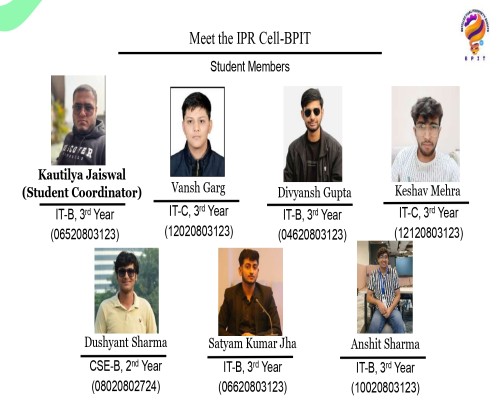
Committee
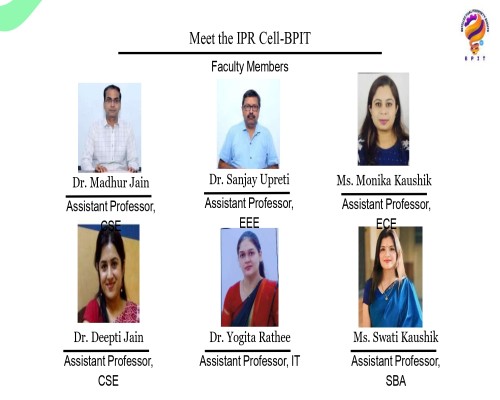
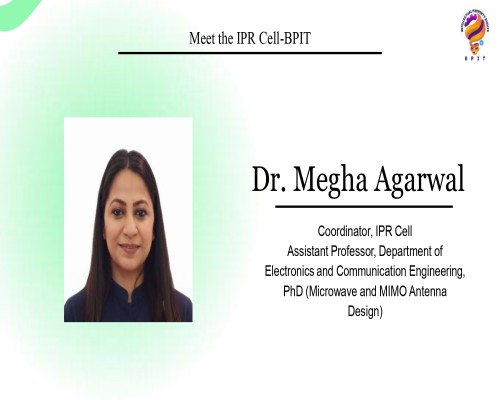
Patent Details (Published/Granted)
Year Wise Patent Details (Published/Granted)
| Patent Details- 2021 (1st January 2021- 31st December 2021) | |||||||||
| Sl. No. | Department | Patent Application No. | Status of Patent (Published / Granted) | Inventor/s Name | Title of the Patent | Applicant/s Name | Patent Filed Date (DD/MM/YYYY) | Patent Published Date / Granted Date (DD/MM/YYYY) | Here, attach Source Proof Screenshots/URL/ Website Links, etc. |
| 1 | EEE | 2021100059 | Published | Dr. Shikha Gupta | Self-cleaning and germ-killing revolving public toilet for covid 19 | Dr. Shikha Gupta | 10-3-2021 | 1-6-2021 | Website Link |
| 2 | IT | 2021106405 | Granted | Harshita Chadha, Dr. Nitish Pathak, Neelam Sharma, Suman Mann, Archana Balyan,Vinita Rohilla,Shrikant V. Sonekar, Satish R. Vaishnav | UNCLOG: A Drone-based Traffic Congestion Mitigation System | Harshita Chadha, Dr. Nitish Pathak, Neelam Sharma, Suman Mann, Archana Balyan,Vinita Rohilla,Shrikant V. Sonekar, Satish R. Vaishnav | 15-04-2021 | 22-08-2021 | Website Link |
| 3 | IT | 202111046067 | Published | Antim Dev Mishra, Dr. Arti Vaish, Dr. Monika Jain, Dr. Nitish Pathak, Neelam Sharma, Amit Rathi, Dr Vikas Singh Bhadoria, Dr. Garima Goswami, Dr. Pankaj Kumar Goswami | IoT based Cost-Effective Drip Monitoring System with SMS Alert under COVID-19 Situation | Antim Dev Mishra, Dr. Arti Vaish, Dr. Monika Jain, Dr. Nitish Pathak, Neelam Sharma, Amit Rathi, Dr Vikas Singh Bhadoria, Dr. Garima Goswami, Dr. Pankaj Kumar Goswami | 10-09-2021 | 11-05-2021 | Website Link |
| 4 | IT | 2021106263 | Granted | Gupta, Ritu; Mishra, Anurag and Jain, Sarika | COLOR IMAGE WATER MARKING SCHEME USING PARTIAL HOMOMORPHIC CRYPTO SYSTEM IN ASWDR COMPRESSED DOMAIN | Gupta, Ritu; Mishra, Anurag and Jain, Sarika | 20/08/2021 | 18-Nov-2021 | Website Link |
| 5 | IT | 2021102691 | Granted | Caroleena Ganesh, Aleem Ali, Abhishek Swaroop et al. | AN ION EXCHANGE PROCESS FOR INDUSTRIAL WASTE WATER TREATMENT | Caroleena Ganesh, Aleem Ali, Abhishek Swaroop et al. | 15-05-2021 | 23-06-2021 | Website Link |
| 6 | IT | 202141022174 A | Published | Prabha U., Sachin Chauhan, Abhishek Swaroop et. al. | SYSTEM OF COVID-19 SMART SECURITY BAND WITH ARTIFICIAL INTELLIGENCE | Prabha U., Sachin Chauhan, Abhishek Swaroop et. al. | 18-05-2021 | 18-06-2021 | Website Link |
| 7 | ECE | 202141053048 | Published | Dr.S.Balamurugan, PRUTHIRAJ SWAIN, DR.BALBIR SINGH, DR.A.MANIMARAN, MRS.R.SUJATHA, PANCHAL KETANKUMAR DEVENDRABHAI, PETER JOSE P, DR.PAVIKA SHARMA, DR.RAVI KUMAR, DR.SUSHMA JAISWAL, VIVEK SINGH RAI, TARUN JAISWAL, DR.T.C.MANJUNATH, DR.PAVITHRA G, DR.RAVI J., DR.ARAVIND H.S. | Wearable Sweat Sensor Based Intelligent Device to detect the stress levels of a patent by monitoring Cortisol and Blood Glucose Levels | Dr.S.Balamurugan, PRUTHIRAJ SWAIN, DR.BALBIR SINGH, DR.A.MANIMARAN, MRS.R.SUJATHA, PANCHAL KETANKUMAR DEVENDRABHAI, PETER JOSE P, DR.PAVIKA SHARMA, DR.RAVI KUMAR, DR.SUSHMA JAISWAL, VIVEK SINGH RAI, TARUN JAISWAL, DR.T.C.MANJUNATH, DR.PAVITHRA G, DR.RAVI J., DR.ARAVIND H.S. | 18-11-2021 | 03-12-2021 | Website Link |
| Patent Details- 2022 (1st January 2022- 31st December 2022) | |||||||||
| Sl. No. | Department | Patent Application No. | Status of Patent (Published / Granted) | Inventor/s Name | Title of the Patent | Applicant/s Name | Patent Filed Date (DD/MM/YYYY)Â | Patent Published Date / Granted Date (DD/MM/YYYY) | Here, attach Source Proof Screenshots /URL/ Website Links, etc. |
| 1 | EEE | 202241067469 | Published | Mr. Hemant Kumar Rajput | An Artificial Intelligence and machine learning based smart tractors, agribots, and robotics for remote agricultural operations | Mr. Hemant Kumar Rajput | 11-23-2022 | 12-23-2022 | Website Link |
| 2 | EEE | 202221056581 | Published | Dr. Peeyush Pant | Rare-earth doped material platforms for quantum-nano-photonics process | Dr. Peeyush Pant | 9-7-2022 | 7-22-2022 | Website Link |
| 3 | CSE | 202241013509 | Published | Ms. Deepti Jain | AI-based Diet Recommendation Framework for Alzheimer’s Person | Ms. Deepti jain | 12-03-2022 | 18/03/22 | Website Link |
| 4 | CSE | 202211017545 | Published | Ms. Deepti Jain, Prof. Achal Kaushik, Prof. Pahwa | System to determine Narcissistic Personality Intent of a user by utilizing Machine Learning | Ms. Deepti Jain, Prof. Achal Kaushik, Prof. Pahwa | 26/03/2022 | 01-04-2022 | Website Link |
| 5 | CSE | 202241051172 | Published | Dr. Suman | AN ANALYSIS OF CLASSIFICATION MODELS OF MACHINE LEARNING TO STUDY THE EXISTING DRUG MOLECULES IN TREATING BLOOD CLOTS. | Dr. Suman | Jul 2022 | 16/09/2022 | Website Link |
| 6 | CSE | 202022105865 | Published | Bhawna Suri, Shweta Taneja, Charu Gupta, Palak | System For Detection of Breast Cancer Based on IOT and Machine Learning Algorithms | Bhawna Suri, Shweta Taneja, Charu Gupta, Palak | 18-10-22 | 25-11-22 | Website Link |
| 7 | CSE | 202341005248A | Published | Charu Gupta, Palak Girdhar | Artificial Intelligence healthcare Chat Bot System | Dr. Charu Gupta, Dr. Palak Girdhar | Nov 2022 | 28/02/2023 | Website Link |
| 8 | IT | 202111053777 | Granted | Dr. Nitish Pathak, Neelam Sharma, Dr. Manoj Kumar Gupta, Dr. Gaurav Jindal, Nitin Jain, Dr. Rakesh Kumar Arora, Harshita Chadha, Dr. Naveen Tewari, Dr. Mukesh Joshi, Dr. Sandeep Kumar Budhani | IOT BASED HEALTH MONITORING SYSTEM OVER 4G NETWORK | Dr. Nitish Pathak, Neelam Sharma, Dr. Manoj Kumar Gupta, Dr. Gaurav Jindal, Nitin Jain, Dr. Rakesh Kumar Arora, Harshita Chadha, Dr. Naveen Tewari, Dr. Mukesh Joshi, Dr. Sandeep Kumar Budhani | 23-11-2021 | 22-12-2022 | Website Link |
| 9 | IT | 342231-001 | Granted | Dr. Monika Jain, Dr. Usha Tiwari, Dr. Shiva Pujan Jaiswal, Dr. Vikas Singh Bhadoria, DR. NITISH PATHAK, Dr. Neelam Sharma, Dr. Pankaj Kumar Goswami, Dr. Garima Goswami | THREE PORT CAR CHARGER | DR. MONIKA JAIN, DR. USHA TIWARI, DR. SHIVA PUJAN JAISWAL, DR. VIKAS SINGH BHADORIA, DR. NITISH PATHAK, DR. NEELAM SHARMA, DR. PANKAJ KUMAR GOSWAMI, DR. GARIMA GOSWAMI | 04-09-2021 | 25/03/2022 | Website Link |
| Â | IT | 202211061240 | Published | Dr. Neelam Sharma, DR. NITISH PATHAK, Dr Amit Choudhary, Dr. Savita Ahlawat, Dr. Sangeeta Malik, Dr. Satinder Malik | REAL TIME TRACKING SOLUTION FOR THE LOGISTICS IN A HOSPITALUSING IOT | DR. NEELAM SHARMA, DR. NITISH PATHAK, DR AMIT CHOUDHARY, DR. SAVITA AHLAWAT, DR. SANGEETA MALIK, DR. SATINDER MALIK | 27/10/2022 | 18/11/2022 | Website Link |
| 11 | IT | 202211002463 | Published | 1 . Vishakha Tomar 2 . Nishtha 3 . Sidharth Samanta 4 . Dr. Vipin Kumar Verma 5 . Dr. Ritu Gupta 6 . Dr. S. Saravanan 7 . Dr.K.Baskar 8 . Ranjith S 9 . G. Balachandran 10 . Dr. Brijesh Sathian 11 . Preeti Sehrawat | IOT, CLOUD BASED STROKE- DISEASE CLASSIFICATION AND PREDICTION USING MACHINE LEARNING ALGORITHMS | 1 . Vishakha Tomar 2 . Nishtha 3 . Sidharth Samanta 4 . Dr. Vipin Kumar Verma 5 . Dr. Ritu Gupta 6 . Dr. S. Saravanan 7 . Dr.K.Baskar 8 . Ranjith S 9 . G. Balachandran 10 . Dr. Brijesh Sathian 11 . Preeti Sehrawat | 15/01/2022 | 02-04-2022 | Website Link |
| 12 | IT | 202241074692 | Published | 1 . TADI.CHANDRASEKHAR 2 . Hasan Ali 3 . Yogita Shivaji Hande 4 . Rupali Sachin Vairagade 5 . Dr. Abhilasha Singh 6 . Dr. Ritu Gupta 7 . Prof. Dr. Muhammad Nauman Aftab 8 . Prof. Hepsi Natha 9 . Mr. Suraj Kumar 10 . Dr. Sharad Timaji Tajane 11 . Dr. Krupal Prabhakar Pawar | Automatic smart Health care System to prevent and detection of all types of Tumors based on bacteria to enhance anti-tumor immunotherapy using Artificial Intelligence and Machine Learning Algorithms | 1 . TADI.CHANDRASEKHAR 2 . Hasan Ali 3 . Yogita Shivaji Hande 4 . Rupali Sachin Vairagade 5 . Dr. Abhilasha Singh 6 . Dr. Ritu Gupta 7 . Prof. Dr. Muhammad Nauman Aftab 8 . Prof. Hepsi Natha 9 . Mr. Suraj Kumar 10 . Dr. Sharad Timaji Tajane 11 . Dr. Krupal Prabhakar Pawar | 22/12/2022 | 30/12/2022 | Website Link |
| 13 | IT | 202211006009 | Published | Varsha Sharma | System and Method for Analyzing the Emotions of the Person using Smart Sensors” | Varsha Sharma | 02-04-2022 | 02-11-2022 | Website Link |
| 14 | IT | 202211032842 | Published | Dr. Sarvottam Dixit Dr. Jyoti Singh Raghav Dr. Monika Varshney Ms. Varsha Sharma Mr. Prateek Agrawal | Cloud-based Human Resource Big Data Analysis and Decision Making for Group Enterprises | Ms. Varsha Sharma Mr. Prateek Agrawal | 08-06-22 | 24/6/22 | Website Link |
| 15 | ECE | 202211050113 | Published | 1. Jasdeep Kaur Dhanoa 2. Mukesh Kumar Khandelwal 3. MEGHA AGARWAL 4. Dr. Amita Dev | A COMPACT TWO-PORT THRONE SHAPED ANTENNA DEVICE WITH DUAL STOP BANDS | Indira Gandhi Delhi Technical University for Women (IGDTUW) | 02-09-2022 | 09-09-2022 | Website Link |
| 16 | ECE | 202211039554 | Published | 1 . Praveen Kumar Malik 2 . RASHMI ROGES 3 . SANDEEP SHARMA 4 . ANURADHA BHASIN 5 . Sneha | A compact Wideband Antenna with DGS for internet of Things Application using Long Range(LORA) Technology | 1 . Praveen Kumar Malik 2 . RASHMI ROGES 3 . SANDEEP SHARMA 4 . ANURADHA BHASIN 5 . Sneha | 09-07-2022 | 22-07-2022 | Website Link |
| 17 | ECE | 202211040140 | Published | 1 . Dr. Saneh Lata Yadav 2 . Prof. (Dr.) Anupam Kumar Sharma 3 . Dr. Tanvi Chawla 4 . Aisha Dhankhar 5 . Reenu Batra 6 . Dr. Prashant Vats 7 . JAYANT BHARDWAJ 8 . Dr. Rajesh Yadav 9 . Prof. (Dr.) Ritu Sindhu 10 . Dr. Sarita 11 . Dr. PAWAN KUMAR SHARMA | On -Demand Ordering FOOD Through Online Crowdsourcing Using Machine Learning | 1 . Dr. Saneh Lata Yadav 2 . Prof. (Dr.) Anupam Kumar Sharma 3 . Dr. Tanvi Chawla 4 . Aisha Dhankhar 5 . Reenu Batra 6 . Dr. Prashant Vats 7 . JAYANT BHARDWAJ 8 . Dr. Rajesh Yadav 9 . Prof. (Dr.) Ritu Sindhu 10 . Dr. Sarita 11 . Dr. PAWAN KUMAR SHARMA | 13-07-2022 | 22-07-2022 | Website Link |
| 18 | ECE | 202241040271 | Published | 1. Dr.S.Balamurugan 2 . Ankur Biswas 3 . Hima Bindu Eluri 4 . Dr Prabhavathi S 5 . Dr Bhadrappa Haralayya 6 . Anjan Kumar B S 7 . Dr. KOMAL BHAGAT 8 . Geeta Guwalani 9 . Dr.L.Jayanthi 10 . Dr.G.Kumar | Human Emotion Recognition and Visualisation System Using Artificial Narrow Intelligence | 1. Dr.S.Balamurugan 2 . Ankur Biswas 3 . Hima Bindu Eluri 4 . Dr Prabhavathi S 5 . Dr Bhadrappa Haralayya 6 . Anjan Kumar B S 7 . Dr. KOMAL BHAGAT 8 . Geeta Guwalani 9 . Dr.L.Jayanthi 10 . Dr.G.Kumar | 13-07-2022 | 22-07-2022 | Website Link |
| 19 | ECE | 202211032314 | Published | 1. Mukesh Kumar Khandelwal 2. Jasdeep Kaur Dhanoa 3. MEGHA AGARWAL 4. Dr. Amita Dev | A SYSTEM TO FABRICATE TWO-PORT HEXAGON SHAPED MIMO MICROSTRIP ANTENNA WITH DOUBLE STOP BANDS | Indira Gandhi Delhi Technical University for Women (IGDTUW) | 06-06-2022 | 17-06-2022 | Website Link |
| 20 | ECE | 202111061357 | Published | 1 . Dr. Pavika Sharma 2 . Dr. Kisalaya Chakrabarti 3 . Dr. Shailesh Khapre 4 . Dr. S. Anantha Siva Prakasam 5 . Dr. Sachin Tyagi 6 . Er. Gurpreet Singh | Image Processing based methodology for image segmentation of brain tumors using Artificial Intelligence & Deep Learning | 1 . Dr. Pavika Sharma 2 . Dr. Kisalaya Chakrabarti 3 . Dr. Shailesh Khapre 4 . Dr. S. Anantha Siva Prakasam 5 . Dr. Sachin Tyagi 6 . Er. Gurpreet Singh | 28-12-2021 | 07-01-2022 | Website Link |
| Patent Details- 2023 (1st January 2023- 31st December 2023) | |||||||||
| Sl. No. | Department | Patent Application No. | Status of Patent (Published / Granted) | Inventor/s Name | Title of the Patent | Applicant/s Name | Patent Filed Date (DD/MM/YYYY)Â | Patent Published Date / Granted Date (DD/MM/YYYY) | Here, attach Source Proof Screenshots/ URL/ Website Links, etc. |
| 1 | EEE | 202341029506 A | Published | Dr. Peeyush Pant | Dynamic power allocation for fast and safe charging of electric vehicles using deep learning | Dr. Peeyush Pant | 4-24-2023 | 5-26-2023 | Website Link |
| 2 | EEE | 202341000517 | Published | Mr. Puneet Dixit | Silicon coated nano particles for solar cell composition | Mr. Puneet Dixit | 1-2-2023 | 1-6-2023 | Website Link |
| 3 | CSE | 202341018533 | Published | Dr. Vishal Khatri | MACHINE LEARNING BASED APPROACHES IN SMART ELECTRIC VEHICLES FOR ECODRIVING TO ENERGY ECONOMY MANAGEMENT SYSTEM | Dr. Vishal Khatri | 18/03/2023 | 07-04-2023 | Website Link |
| 4 | CSE | 202311007240 | Published | Dr Renu Dalal, Nidhi Goel, Dr Manju Khari, Dr Shweta Taneja, Dr Bhawna Suri | E-Authentication and notification system using AI | Dr Renu Dalal, Nidhi Goel, Dr Manju Khari, Dr Shweta Taneja, Dr Bhawna Suri | 02-04-2023 | 17/2/2024 | Website Link |
| 5 | CSE | 392866-001 | Granted | Dr. Nitish Pathak, Dr. Neelam Sharma, Dr. Binu Thomas, Dr. Jacob Bose, Dr. B. S. Daga, Dr. Bhavya Alankar, Dr. Mahaveerakannan R | AI-Based Micro GPS Tracking Chip | Dr. Nitish Pathak, Dr. Neelam Sharma, Dr. Binu Thomas, Dr. Jacob Bose, Dr. B. S. Daga, Dr. Bhavya Alankar, Dr. Mahaveerakannan R | 16/08/2023 | 16/10/2023 | Website Link |
| 6 | CSE | 6263864 | Granted | Dr. Neelam Sharma, Dr. Nitish Pathak, Dr. Kapil Kumar Nagwanshi, Dr. Sachin Kumar, Dr. Nitish Kumar Ojha, Shalini Nayak, Dr. Bhavya Alankar | Internet of Things based Data Processing Device | Dr. Neelam Sharma, Dr. Nitish Pathak, Dr. Kapil Kumar Nagwanshi, Dr. Sachin Kumar, Dr. Nitish Kumar Ojha, Shalini Nayak, Dr. Bhavya Alankar | 23-02-2023 | 02-03-2023 | Website Link |
| 7 | CSE | 202311075031 | Published | Dr. Pavan Kumar Pandey, Dr.Vineet Kansal, Dr.Abhishek Swaroop, Dr. Monika Arora | PUBLIC KEY INFRASTRUCTURE BASED SECURE MULTIPATH ROUTING IN VEHICULAR AD-HOC NETWORKS | Dr. Pavan Kumar Pandey, Dr.Vineet Kansal, Dr.Abhishek Swaroop, Dr. Monika Arora | 03-11-2023 | 24/11/2023 | Website Link |
| 8 | CSE | 389750-001 | Granted | Dr. Nitish Pathak, Dr. Neelam Sharma, Dr. Archana Balyan, Dr. Suman Mann, Dr. Sumit Jain, Dr. Alka Pant | Machine Learning based Mobile Jammer | Dr. Nitish Pathak, Dr. Neelam Sharma, Dr. Archana Balyan, Dr. Suman Mann, Dr. Sumit Jain, Dr. Alka Pant | 06-07-2023 | 19/01/2024 | Website Link |
| 9 | CSE | 400286-001 | Granted | Dr. Nitish Pathak, Dr. Neelam Sharma, Dr. Monica Bhutani, Dr. Monica Gupta, Dr. Bhavya Alankar, Dr Jeetendra Pande, Harsh Vardhan Pant, Dr. Kirti Gupta | Students Behaviour Monitoring Device | Dr. Nitish Pathak, Dr. Neelam Sharma, Dr. Monica Bhutani, Dr. Monica Gupta, Dr. Bhavya Alankar, Dr Jeetendra Pande, Harsh Vardhan Pant, Dr. Kirti Gupta | 20/11/2023 | 19/01/2024 | Website Link |
| 10 | IT | 380966-001 | Patent Granted | Dr. Anand Nayyar Dr. Rudra Rameshwar Dr. Rajani Kumari Dr. Piyush Kumar Shukla Dr. Rachna Jain | IOT BASED WEARABLE HEALTH MONITORING DEVICE | Dr. Anand Nayyar Dr. Rudra Rameshwar Dr. Rajani Kumari Dr. Piyush Kumar Shukla Dr. Rachna Jain | 7-3-2023 | 23/5/2023 | Website Link |
| 11 | IT | 6285565 | Patent Granted | Dr. Anand Nayyar Dr. Rachna Jain Ms. Shipra Chhabra Dr. Jolly Parikh Dr. Saji Maliakal Antony Ms. Nidhi Gaur Ms. Varsha Shrivastava | Artificial intelligence based smart glasses for determining retinal stress | Dr. Anand Nayyar Dr. Rachna Jain Ms. Shipra Chhabra Dr. Jolly Parikh Dr. Saji Maliakal Antony Ms. Nidhi Gaur Ms. Varsha Shrivastava | 26-05-2023 | 05-06-2023 | Website Link |
| 12 | IT | 202311002117 | Published | Dr. Manoj Kumar Gupta, Ms. Dimple Tiwari, Dr. Bhoopesh Singh Bhati, Dr. Bharti Nagpal, Prof(Dr.) Prashant Singh, Mr. Dhyanendra Jain, Mr. Amit Kumar Pandey | A Proficient Blockchain-Enabled Sentiment Analysis Model Employing Bidirectional Encoder Representations from Transformers | Dr. Manoj Kumar Gupta, Ms. Dimple Tiwari, Dr. Bhoopesh Singh Bhati, Dr. Bharti Nagpal, Prof(Dr.) Prashant Singh, Mr. Dhyanendra Jain, Mr. Amit Kumar Pandey | 10-Jan-23 | 13-Jan-23 | |
| 13 | ECE | 202211050113 | Granted | Jasdeep Kaur Dhanoa, Mukesh Kumar Khandelwal, MEGHA AGARWAL, Dr. Amita Dev | A COMPACT TWO-PORT THRONE SHAPED ANTENNA DEVICE WITH DUAL STOP BANDS | Indira Gandhi Delhi Technical University for Women (IGDTUW) | 02-09-2022 | 05-09-2023 | Website Link |
| 14 | ECE | 202311051262 | Published | Mr Risheek Kumar, Dr Sandeep Sharma Dr Anuradha Bhasin Ms Rashmi Roges | Design of a Compact Wideband Hexagonal Antenna for WiFi, WiMax, and IOT Applications 202311051262 | Mr Risheek Kumar, Dr Sandeep Sharma Dr Anuradha Bhasin Ms Rashmi Roges | 31-07-2023 | 01-09-2023 | Website Link |
| 15 | ECE | 202211032314 | Granted | Mukesh Kumar Khandelwal, Jasdeep Kaur Dhanoa, MEGHA AGARWAL, Dr. Amita Dev | A SYSTEM TO FABRICATE TWO-PORT HEXAGON SHAPED MIMO MICROSTRIP ANTENNA WITH DOUBLE STOP BANDS | Indira Gandhi Delhi Technical University for Women (IGDTUW) | 06-06-2022 | 28-07-2023 | Website Link |
| 16 | ECE | 379793-001 | Published | Dr.P.Vivekanandan, Dr.M.Sudha, Dr. Jyothi A P, Dr. Komal Mehta Bhagat | A Wireless Smart Camera System | Dr.P.Vivekanandan, Dr.M.Sudha, Dr. Jyothi A P, Dr. Komal Mehta Bhagat | 21-02-2023 | 19-05-2023 | Website Link |
| 17 | ME | 202311056182A | Published | Dr. Rajesh Kumar | System and Method Developed for shape memory alloy composite in aotomobile industry. | Dr. Rajesh Kumar Mr. Pardeep Ms. Pooja Mr. Dharamvir Dixit | 22-08-2023 | 22-09-2023 | Website Link |
| 18 | ME | 397576-001 | Granted | Mr.K.KANNAKUMAR K.P.KANAGARAJ | Robotic Trolley for Material Hanndling | Dr. Rajesh Kumar | 14-10-2023 | 14-12-2023 | Website Link |
| Patent Details- 2024 (1st January 2024- 31st December 2024) | |||||||||
| Sl. No. | Department | Patent Application No. | Status of Patent (Published / Granted) | Inventor/s Name | Title of the Patent | Applicant/s Name | Patent Filed Date (DD/MM/YYYY) | Patent Published Date / Granted Date (DD/MM/YYYY) | Here, attach Source Proof Screenshots/URL/ Website Links, etc. |
| 1 | IT | 202411069185 A | PUBLISHED | Uma Rani, Parveen Kumari, Manisha Sharma, Archana Rohilla, Smriti Dwivedi, Sabnam Kumari, Praveen Kantha, Neha Gupta | ADVANCED AI-BASED SPRINKLER SYSTEM FOR IRRIGATION | Uma Rani, Parveen Kumari, Manisha Sharma, Archana Rohilla, Smriti Dwivedi, Sabnam Kumari, Praveen Kantha, Neha Gupta | 12-09-2024 | 04-10-2024 | Website link |
| 2 | IT | 430635-001 | Granted | Dr. Nitish Pathak, Dr. Neelam Sharma,Dr. Saurabh Chandra,Prof. Praveen Malik, Dr. Arpana Chaturvedi, Dr. Abhishek Bhattacharya,Dr. Soumi Dutta | AI based facial recognition device | Dr. Nitish Pathak, Dr. Neelam Sharma,Dr. Saurabh Chandra,Prof. Praveen Malik, Dr. Arpana Chaturvedi, Dr. Abhishek Bhattacharya,Dr. Soumi Dutta | 16/09/2024 | 13/11/2024 | Website Link |
| 3 | IT | 418150-001 | Granted | Dr. Nitish Pathak, Dr.Geetanjali Sharma, Ms. Neelam Nehra,Dr. Neelam Sharma,Dr.Arpana Chaturvedi | MACHINE LEARNING BASED CLOUD DATA ANALYSIS DEVICE | Dr. Nitish Pathak, Dr.Geetanjali Sharma, Ms. Neelam Nehra,Dr. Neelam Sharma,Dr.Arpana Chaturvedi” | 27/05/2024 | 04-07-2024 | Website Link |
| 4 | IT | 406646-001 | Granted | Dr. Nitish Pathak , Dr. Neelam Sharma, Dr. Binu Thomas, Dr. B. S. Daga, Dr. Arpana Chaturvedi | AI BASED ONLINE TEACHING DEVICE | Dr. Nitish Pathak , Dr. Neelam Sharma, Dr. Binu Thomas, Dr. B. S. Daga, Dr. Arpana Chaturvedi | 05-02-2024 | 12-04-2024 | Website Link |
| 5 | IT | 2.02311E+11 | Granted | 1.Dr. Pavan Kumar Pandey 2.Dr. Vineet Kansal 3.Dr. Abhishek Swaroop 4.Dr. Monika Arora | PUBLIC KEY INFRASTRUCTURE BASED SECURE MULTIPATH ROUTING IN VEHICULAR AD-HOC NETWORKS | 1.Dr. Pavan Kumar Pandey 2.Dr. Vineet Kansal 3.Dr. Abhishek Swaroop 4.Dr. Monika Arora | 3-11-23 | 9-12-2024 | Website Link |
| 6 | CSE | L-144100/2024 | Published | Dr. Bhawna Suri, Dr. Shweta Taneja, Dr. Monika Arora | CONFMAN-AN AUTOMATED CONFERENCE MANAGEMENT PROCESS | Dr. Bhawna Suri, Dr. Shweta Taneja, Dr. Monika Arora | 03-01-2024 | 26/02/2024 | |
| 7 | Applied Sciences | 420797-001 | Granted | Dr. Abhijit Nayak | HIGH-EFFICIENCY THERMOELECTRIC ENERGY CONVERSION DEVICE | Dr. Abhijit Nayak Mr. Pardeep Ms. Pooja Rani Dr. Rajesh Kumar | 21-06-2024 | 15-07-2024 | Sign in to continue to Google Drive |
| 8 | SBA | 2.02411E+11 | Published | 1.Prof. Sundram Priyadarshnie 2 . Dr. A. G. Mythili 3 . Dr. Dinesh Kumar Ramji Bhai Chavda 4 . Dr. Kawerinder Singh Sidhu 5 . Dr. Poornima 6 . Ms. P. Deepa 7 . Dr. Divya Nigam 8 . Mrs. J. Angel Priya 9 . Dr. Susan Alex 10 . Dr. Ambili Madhu Thampi 11 . Pavithra. C.R 12 . Dr. A. Muthulakshmi | IMPACT OF RECENT GLOBAL SLUMP ON INDIAN CAPITAL MARKET | 1. Prof. Sundram Priyadarshnie 2 . Dr. A. G. Mythili 3 . Dr. Dinesh Kumar Ramji Bhai Chavda 4 . Dr. Kawerinder Singh Sidhu 5 . Dr. Poornima 6 . Ms. P. Deepa 7 . Dr. Divya Nigam 8 . Mrs. J. Angel Priya 9 . Dr. Susan Alex 10 . Dr. Ambili Madhu Thampi 11 . Pavithra. C.R 12 . Dr. A. Muthulakshmi | 16-11-2024 | ||
| 9 | ECE | 406169-001 | Granted | 1. Dr. Chandan Choubey 2. Dr. Ellappan V 3. Dr. K. Prabhavathi 4. Dr. Rafi Mohammed Shaikh 5. Komal Arora 6. Dr. Komal Mehta Bhagat 7. Arun Raj S R 8. Dr. Prasun Chakrabarti | IoT Based Device to manage Home Appliance through Hand Gesture | 1. Dr. Chandan Choubey 2. Dr. Ellappan V 3. Dr. K. Prabhavathi 4. Dr. Rafi Mohammed Shaikh 5. Komal Arora 6. Dr. Komal Mehta Bhagat 7. Arun Raj S R 8. Dr. Prasun Chakrabarti | 31/01/2024 | 18/04/2024 | |
| 10 | IT | 389750-001 | Granted | Dr. Neelam Sharma Dr. Nitish Pathak Dr. Archana Balyan Dr. Suman Mann Sumit Jain Dr. Alka Pant | Machine Learning based Mobile Jammer | Dr. Neelam Sharma Dr. Nitish Pathak Dr. Archana Balyan Dr. Suman Mann Sumit Jain Dr. Alka Pant | 06-07-2023 | 19/01/2024 | Website Link |
| 11 | CSE | 2.02411E+11 | Published | 1 . Dr. Rahul Sharma 2 . Dr. Neetu Jain 3 . Dr. Sushil Kumar 4 . Dr. Alka Saini 5 . Mr. Ajeet Singh 6 . Ms. Prachi Gupta 7 . Mr. Zubair Iqbal 8 . Dr. Priyanka Kumari 9 . Mr. Vishnu Kant Soni 10 . Ms. Muskan Naik 11 . Dr. Ankit Verma 12 . Ms. Vishakha Sehdev Verma | Device and Procedure for evaluating a user’s mental structure using wearable sensors | 1 . Dr. Rahul Sharma 2 . Dr. Neetu Jain 3 . Dr. Sushil Kumar 4 . Dr. Alka Saini 5 . Mr. Ajeet Singh 6 . Ms. Prachi Gupta 7 . Mr. Zubair Iqbal 8 . Dr. Priyanka Kumari 9 . Mr. Vishnu Kant Soni 10 . Ms. Muskan Naik 11 . Dr. Ankit Verma 12 . Ms. Vishakha Sehdev Verma | 10-4-2024 | 10-5-2024 | |
| 12 | IT | 409623-001 | Granted | Dr. Anand Nayyar Dr. Rachna Jain Ms. Shipra Chhabra Ms. Nidhi Gaur Ms. Varsha Shrivastava Ms. Shikha Bhalla | SMART INHALER | Dr. Anand Nayyar Dr. Rachna Jain Ms. Shipra Chhabra Ms. Nidhi Gaur Ms. Varsha Shrivastava Ms. Shikha Bhalla | 07-03-2024 | 10-05-2024 | Website Link |
| 13 | IT | 409621-001 | Granted | Dr. Rachna Jain Dr. Jolly Parikh Dr. Yugnanda Dr Gargi Mishra Dr. Rakhi Nupur Chugh | IOT BASED MEDICATION DISPENSER | Dr. Rachna Jain Dr. Jolly Parikh Dr. Yugnanda Dr Gargi Mishra Dr. Rakhi Nupur Chugh | 07-03-2024 | 02-05-2024 | Website Link |
| 14 | IT | 425803-001 | Granted | Dr Anand Nayyar Dr. Jolly Parikh Dr. Rachna Jain Dr. Yugnanda Dr. Saji Maliakal Antony | SMART NERVE ACTIVATION DEVICE FOR HEALTHCARE TREATMENT | Dr Anand Nayyar Dr. Jolly Parikh Dr. Rachna Jain Dr. Yugnanda Dr. Saji Maliakal Antony | 05-08-2024 | 12-09-2024 | Website Link |
| 15 | IT | 400063-001 | Granted | Dr. Anand Nayyar Dr. Mamta Madan Dr. Rachna Jain Dr. Vani Nijhawan Mohit Mathur | Artificial Intelligence Powered Robot For Home Assistance | Dr. Anand Nayyar Dr. Mamta Madan Dr. Rachna Jain Dr. Vani Nijhawan Mohit Mathur | 16 Nov 2023 | 19/01/2024 | Website Link |
| 16 | EEE | 2.02441E+11 | Published | Dr Peluru Janarhana, Dr Anuradha, Yerramsetty Pavani, Dr Nellore Manoj Kumar, Abanikanta Pattnayak, Charu Varshney, Shalini Sharma,Dr CH Hussaian Basha, Dr Shaik Rafi kiran , P. Shiva Kumar | NEURAL NETWORK-ASSISTED DIAGNOSISOF ELECTRICALJUNCTION ANOMALIES IN EVS | Dr Peluru Janarhana, Dr Anuradha, Yerramsetty Pavani, Dr Nellore Manoj Kumar, Abanikanta Pattnayak, Charu Varshney, Shalini Sharma,Dr CH Hussaian Basha, Dr Shaik Rafi kiran , P. Shiva Kumar | 08.04.2024 | 19.04.2024 | Website Link |
| 17 | EEE | 2.02411E+11 | Published | Charu Varshney, Dr Dnyaneshwar P Pawar, Dr Sowmiya L.M., R Rajeshwari, Dr VT Ram Pawan Kumar, P Yogalakshmi, Anuradha M V Dr Shikha Gupra, B Siva Sankar, Dr S Rasheed Mansoor Ali | Artificial intelligence driven communication skill development system | Charu Varshney, Dr Dnyaneshwar P Pawar, Dr Sowmiya L.M., R Rajeshwari, Dr VT Ram Pawan Kumar, P Yogalakshmi, Anuradha M V Dr Shikha Gupra, B Siva Sankar, Dr S Rasheed Mansoor Ali | 31.03.2024 | 03.05.24 | Website Link |
| 18 | IT | 409507-001 | Granted | Dr. Virendra Kumar Dr. Nitish Pathak Dr. B. S. Daga Apoorva Verma Dr. Leena Bhatia Dr. Neelam Sharma Anjani Kumar Singha | AI Based Signboard for Marketing | Dr. Virendra Kumar Dr. Nitish Pathak Dr. B. S. Daga Apoorva Verma Dr. Leena Bhatia Dr. Neelam Sharma Anjani Kumar Singha | 07-03-2024 | 03-05-2024 | Website Link |
Patent Details- 2025 (1st January 2025 to 31st December 2025)
| Â | Â | Â | Â | Â | Â | Â | Â | Â | Â | Â |